Table of contents
Most junk removal owners don't have a marketing problem. They have an order of operations problem.
They pay an agency for SEO before they have 20 reviews. They burn $2,000 on Google Ads with no cash in the bank. They print a truck wrap before the phone rings. Meanwhile the cheap, fast stuff that actually gets a brand new company its first jobs sits there, untouched, because it's not sexy.
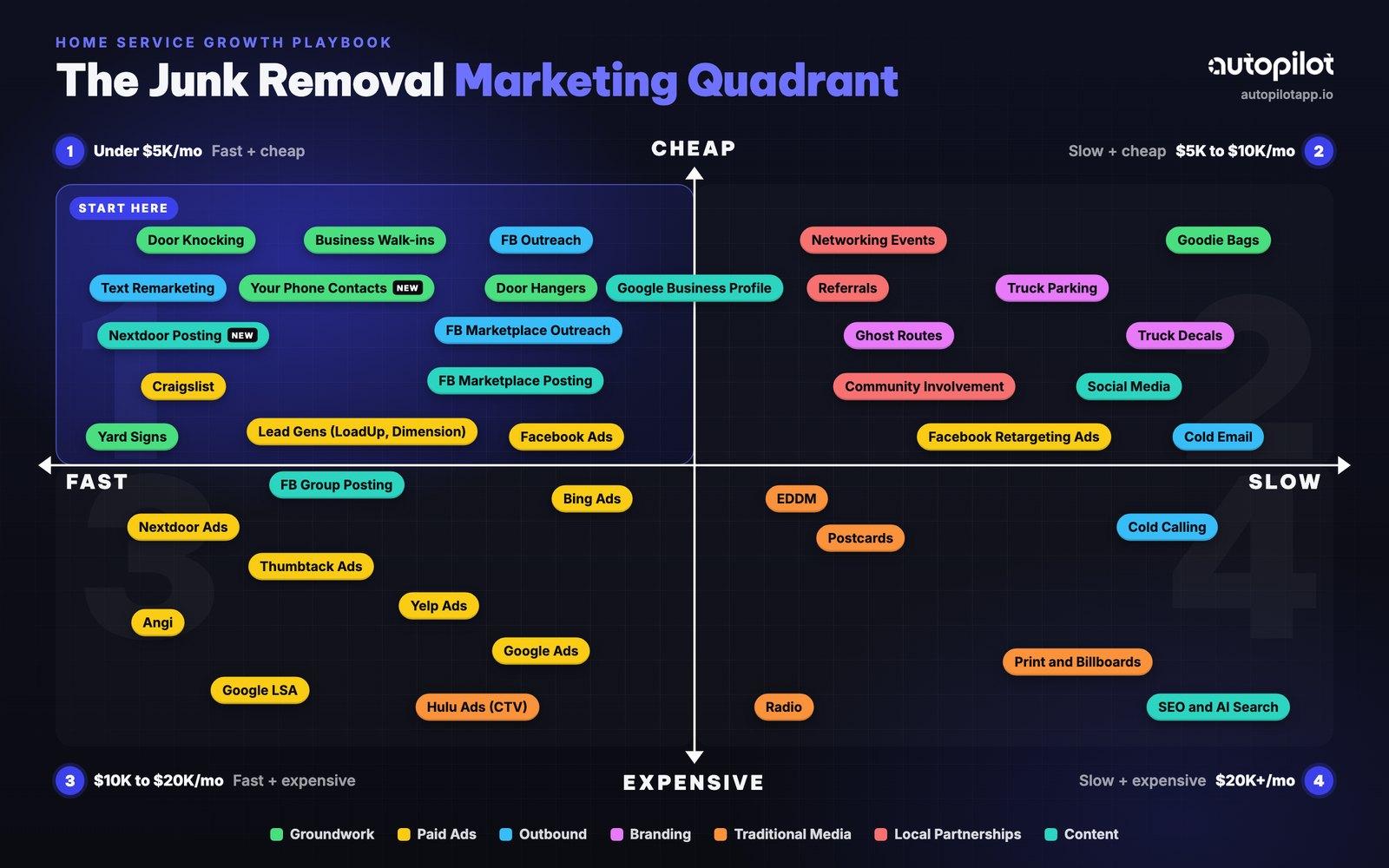
So I built a map. Every way I know to get a junk removal job, sorted on two lines: how fast it gets you a job and how much it costs. That gives you four boxes. Each box lines up with a revenue stage. Start in the top left, stay there until the money says move, and never stop doing what got you there.
I ran a million-dollar junk removal company, sold it, and I'm now building Autopilot, the software I wish I had back then. This is the updated, deep version of the quadrant, with every tactic broken down, real screenshots of what each one looks like, and the exact numbers I'd use.
How to Read the Quadrant
Two lines split the chart.
- Left to right is speed. Fast means you can do it this week and the phone rings this month. Slow means it compounds: you do it for months before it pays, and then it pays for years.
- Top to bottom is cost. Cheap means mostly your time, or a few bucks. Expensive means real money every month, usually to a platform or an agency.
Every tactic is a colored pill. The color is the type of marketing:
| Color | Category | What it means |
|---|---|---|
| Green | Groundwork | Boots on the ground. Yard signs, door hangers, walking into businesses. |
| Yellow | Paid Ads | You pay a platform to show you to people or hand you leads. |
| Blue | Outbound | You reach out first: messages, texts, emails, calls. |
| Pink | Branding | People see your name and truck around town until they remember it. |
| Orange | Traditional Media | Mail, radio, print, TV. Big reach, big price. |
| Red | Local Partnerships | Relationships that send you work: realtors, property managers, networking groups. |
| Teal | Content | Things you post or publish that keep working: profiles, posts, SEO. |
The four stages
Each box matches a monthly gross revenue stage. These numbers are what I've seen work in my market. Your market and your trade will move them a little.
- Under $5K/mo: Fast and cheap. You have no money and no time to wait. You need jobs now.
- $5K to $10K/mo: Slow and cheap. You're consistent. Now start the stuff that builds a name.
- $10K to $20K/mo: Fast and expensive. Now you can buy leads, carefully.
- $20K+/mo: Slow and expensive. Now you can afford to plant trees: SEO agencies, radio, mail.
This assumes your margins are healthy. If you're on the truck doing everything yourself, you should be keeping around 50%. Once you add payroll, workers comp, insurance, and paid ads, you should still be at 20 to 30% minimum. If you're not profitable, more marketing just loses money faster. (Here's how to check your junk removal profit margins.)
Three rules that make it work
1. Your money and your focus stay in your box. If an opportunity from another box falls in your lap, take it. If you're great at cold email or you're a natural on TikTok, use it. But your budget and your daily hours belong to your current box until you've cracked it.
2. You move on when the revenue is consistent, not when you hit it once. Hit $5K in month one, month two, month three? Now you can start teetering into box two.
3. You never stop the last box. This is the one everybody gets wrong. Box one doesn't turn off when you move to box two. You turn each box into SOPs (standard operating procedures, written commitments like "200 yard signs a month") and they keep running while you add the next layer. That's how you build a machine instead of a hustle. I wrote a whole guide on building SOPs for each quadrant.
Stage 1: Under $5K a Month (Fast and Cheap)
What do you want when you're starting out? Come on. Cheap and fast leads. You don't have money and you don't have time to wait on Google.
Let's be real: these are the hardest ways to get jobs. You're going to work for every one of them. Later, repeats, referrals, reviews, ads, and SEO will kick in and the phone will ring on its own. But that only happens after you build a business, and this box is how you build it.
Here's every tactic in the box, in the order I'd do them.
1. Yard signs (the number one tactic)
If I could only pick one, it's yard signs. Bar none, your most effective right-away leads. I've run the numbers, I've talked to hundreds of operators who do them, and I've done them myself.
The math:
- 100 big signs (18 by 24 inch) cost about $350 with metal stakes, about $250 without. You don't need new stakes every order. Put half in the ground and zip tie the rest to poles and chain link fences.
- 100 signs gets you about 10 phone calls on average. Sometimes 5, sometimes 20, depending on placement and your city. Call it about 5 jobs.
- 300 to 400 signs a month gets most people their first 20 jobs. Some operators do $10K to $20K a month from yard signs alone.
- Order the next batch before you run out. They take about a week to ship.
Rules: keep the sign dead simple (big words, one phone number), and always use a tracking number. Some people will get mad about your signs. Code enforcement might call. A tracking number lets you see exactly how many calls the signs drive and keeps your main line clean. You can put 100 signs out in a day. Two days, tops.
Can't afford 100? Print "JUNK REMOVAL" and your number on bright yellow paper and staple it to telephone poles. Not as good, but it's something.
2. Your phone contacts (new on the quadrant)
This one wasn't on the original chart and it should have been. Open your phone and scroll your contacts. I've got 404. Record one selfie video:
"Hey, I just started a junk removal company. It would mean a lot if you know anybody who needs anything hauled off, or if you've got something yourself. I know this is out of nowhere..."
Send it to everybody. Put your pride and your ego aside. You'll be surprised how many people give you props, and somebody always knows somebody. Plan on at least one job. Even if nobody books, ask friends and family to let you haul something so you can start stacking Google reviews with real photos.
3. Craigslist
Craigslist isn't what it used to be, but it's $5 a post and plenty of haulers still get their first job there. I got jobs from it when I started four years ago.
Post in services, then labor and moving. Once a day is about $150 a month. Once a week is $20. There's a repost button, so it's quick. In a big market, post twice a day: morning and afternoon. Test it hard for one full month, then keep it or cut it based on the calls.
4. Facebook: the most powerful free platform you have
Facebook gets five pills on the chart for a reason. It's the best platform for getting leads, and how many you get depends entirely on how hard you hustle it. Here's each piece.
FB Outreach. Reach out to people. Add local friends every day (my SOP was 100 friend requests a day). Message realtors, property managers, and any business that would use a hauler (my SOP was 10 realtor messages a day). They're all on Facebook.
FB Marketplace Outreach. Go to the Free section of Marketplace every day. Those are people who want stuff gone. Message them: "I know you're trying to get some money for this, but if it doesn't go, hit me up. I'd love to help."
FB Marketplace Posting. You can list your junk removal service right on Marketplace. Search "junk removal" in your city and you'll see your competitors doing it. Facebook takes the listings down eventually. Just repost. Beat everybody else with better photos: you, smiling, in front of a clean truck. Be family friendly and a little fun. Their photos are clip art and junk piles.
FB Group Posting. Join every local group that makes sense: community groups, buy and sell groups, yard sale groups, mom groups, real estate groups. Post in 10 to 20 groups minimum, 100 if your city is big. You'll find out fast which groups let you through. Keep those.
A tool like Group Posting can schedule one post across many groups at once. And don't be a weirdo: give value, be funny, post a photo of you in front of the truck, talk about donating and recycling.
The SOP: 20 actions a day. Stories, reels, 10 group posts, 10 outreach messages, friend adds. Whatever the mix, 20 a day. Do that for a month and you can get 20 jobs from Facebook alone. Worst case, plan on 5.
5. Facebook Ads ($10 a day)
Facebook Ads is the one paid tactic in box one because you can start at $10 a day ($300 a month). Do them right and you'll get 3 to 5 jobs off that spend, plus a lot of bad leads you'll learn from. How many you get depends on your photo, your copy, how fast you call people back, and how well you follow up.
Keep the setup simple. Here's what the Jedi Junk Removal ad account looked like: a messages campaign for Ventura, a lead form campaign, cold audiences split by city, and one retargeting campaign for everyone who already engaged.
Two things to do on day one, even before you run a single ad: install the Facebook pixel on your website (it's what makes retargeting work in stage two), and go study the Meta Ad Library to see what other haulers are running.
Go deeper: the junk removal Facebook ads guide.
6. Nextdoor posting (new on the quadrant)
I didn't use Nextdoor, but I've watched people crush it, and it belongs here. It's the Facebook playbook on a neighborhood platform. Make a business page, but mostly brand your personal profile as the local junk guy. Watch the free and for sale sections. Reply to people. Comment on posts. Then, once in a while, make your own post about donations, recycling, and helping neighbors clear out.
Don't spam. Treat it like a real community. The SOP is 5 actions a day, about 15 minutes. Hustle it and it's good for around 5 jobs.
7. Business walk-ins
After yard signs, walk-ins are the next most effective for immediate jobs. Drive shopping plazas and look behind the buildings for overflowing dumpsters. Waste Management doesn't haul the overflow. Walk in, shake hands, look them in the eye, and offer to clear it today. Give them a good deal, get the job on the spot, and get a review on the spot.
The classic targets are apartment complexes, property managers, storage units, assisted living, nursing homes, and real estate offices. Just know they're slower: most want a certificate of insurance first, and some make you sign up on a vendor platform before they can pay you. Here's what insurance you need for junk removal.
SOP: 10 walk-ins a day.
8. Door knocking and door hangers
They work. If you knock 200 doors you'll get a couple of jobs. It's just not the best use of your time compared to yard signs. Junk is a softer sale than windows or solar: "Hey, if you've got stuff you need gone, I'll take it." No hard sell.
Where door hangers shine: after every job, hang 10 on the neighbors' doors. Your truck was just there. They saw it.
9. Lead gen apps (LoadUp, Dimension)
Lead gen apps hand you jobs. You'll make less per job, but they keep you busy and pay the bills while your signs and Facebook warm up. Same idea as driving DoorDash between jobs.
10. Two things to set up now, even though they're slow
Google Business Profile. I go back and forth on where this pill goes. It doesn't bring you much until you've stacked reviews and started ranking, so it's slow. But it's free, so set it up on day one and feed it reviews and job photos from every friend and family haul. That's why it sits right on the line.
Text remarketing. Fast and cheap, but you don't have a customer list yet, so skip it for now. Once you have past customers, a quarterly "Hey, we're in your area this week" text is one of the cheapest jobs you'll ever book.
What I'd cross off in stage 1
In the newer video I literally took a red pen to the chart. If you're under $5K and broke, ignore door knocking (yard signs are a better use of the same hours), lead gens if you can avoid them, text remarketing (no list yet), and anything below the line.
Your first 20 jobs: the 30-day plan
Here's the whole box turned into a scoreboard. These are conservative, worst-case numbers from the video.
| Tactic | Daily or monthly commitment | Cost | Expected jobs |
|---|---|---|---|
| Yard signs | 100 signs (shoot for 300 to 400) | $250 to $350 per 100 | 5 per 100 |
| Phone contacts | One selfie video to every contact | Free | 1 |
| Craigslist | Post daily (weekly minimum) | $20 to $150/mo | 1 |
| Facebook (all of it) | 20 actions a day | Free | 5 |
| Facebook Ads | $10 a day | $300/mo | 3 to 5 |
| Nextdoor | 5 actions a day | Free | 5 |
| Business walk-ins | 10 a day | Gas | Bonus |
That's over 20 jobs in month one, worst case. At a $250 average ticket (beginner pricing) that's about $5,000. At a pro's $550 average ticket, it's $11,000.
Split your day. Do the digital stuff (Facebook, Nextdoor, Craigslist) in the morning or whenever you're sharpest at a screen. Do signs and walk-ins in the field. And the moment jobs start coming in, put big lettering decals on your truck or trailer. You don't need a full wrap yet.
What else are you doing with your day? You trying to grow this thing or not?
Stage 2: $5K to $10K a Month (Slow and Cheap)
You've cracked $5K a few months in a row. Your box one SOPs keep running. Now you start the stuff that's cheap but takes a while: getting known.
Goodie bags
My favorite cheap tactic in the whole chart. Buy the 20 cent brown paper bags on Amazon. Fill them with Dollar Tree candy, a business card, and a tracking number. Then hand out 15 a day to apartment complexes, property management companies, real estate offices, and nursing homes. Ask for the manager. These are the people who call a hauler every single month.
Networking events and referrals
BNI, the Chamber of Commerce, trade associations, local business mixers. Some people love this. If you're good at showing your face and talking, go to every one. Referrals grow out of networking and out of happy customers, and they go hand in hand.
Community involvement
Sponsor the Little League team. Do a free cleanup for the church or the veterans hall. Show up. It's slow, and it's how a small town decides who "their" junk guy is.
Truck branding, truck parking, and ghost routes
- Truck decals and branding. Big lettering first, full wrap later. A branded truck is a billboard that drives to rich neighborhoods every day.
- Truck parking. Park it where people see it: busy corners, outside the hardware store, at events. Throw the dump trailer bed up so it looks like a show. Nosy people take photos and call later.
- Ghost routes. Drive the branded truck through the neighborhoods you want, even when you don't have a job there. My guys drove all day anyway. Make the route count.
Social media
Social media could be three classes on its own. TikTok, Instagram, Facebook Reels, YouTube, YouTube Shorts, LinkedIn, X. Where's the most power for junk removal? Facebook. Start there. One operator I know has been in business eight years and still posts 20 times a day across platforms. That's why his phone rings.
The easiest post in the world: before and after photos of today's job, what you hauled, a starting price, and where you work.
Facebook retargeting ads
Remember the pixel from stage one? Now it pays off. Retargeting shows your ads to people who already visited your website. They know your name, so it's cheap and it converts.
Text remarketing and cold email
Now you have a customer list. Text past customers every quarter. Start cold email to property managers and realtors. Cold calling sits all the way out on the slow side: it works, but it's a grind until you have a system.
Stage 3: $10K to $20K a Month (Fast and Expensive)
This is the box everyone wants to skip to, because it's a never-ending river of leads. Google will always favor people who pay. But paid leads only work once your box one and box two machines are running and you can afford to learn.
Google Ads
Google Ads is a must if you really want to scale. But here's my rule: don't touch Google Ads until you have $15,000 in the bank for it. Stack cash in stage two first.
What good looks like: a 3x return on ad spend minimum on a normal month. A really bad, slow month might be 2x. A great month might be 5x. I finished my last full year at about 4x. If you're not in the 3x to 5x range, something is broken: the ads, the agency, or how fast you answer the phone. Full playbook: junk removal Google Ads.
Google Local Services Ads (LSA)
The "Google Guaranteed" ads at the very top of the page. You pay per lead, not per click, and the badge builds trust. This is fast and expensive because the leads cost real money in competitive markets.
Thumbtack, Yelp, and Angi (careful)
These are lead aggregators. They sell the same lead to multiple companies, so you're racing three other haulers to the phone. A lot of operators think they're scams. They're not exactly scams, but they're dangerous if you don't respond in minutes and track your cost per job.
Nextdoor Ads, Bing Ads, and Hulu (CTV)
- Nextdoor Ads are fast because the targeting is the neighborhood itself.
- Bing Ads sit right next to the line: cheaper clicks than Google, an older audience, smaller volume.
- Hulu and connected TV ads are expensive, but I know operators crushing it with them. TV in your market with a real face on it is a strong play once you have the budget.
Stage 4: $20K+ a Month (Slow and Expensive)
At $20K a month you should still be running margins between 30% and 50% if you're on the truck. Now you can afford to plant trees: things that take months to pay but pay for years.
SEO and AI search
You should be doing basic SEO yourself from day one: a real website, a Google Business Profile, reviews, job photos. What lives in this box is paying an SEO agency, because good ones are expensive. And in 2026 SEO includes showing up when people ask ChatGPT or Google's AI who to call. Start with the junk removal SEO guide and a junk removal website that actually converts.
Radio
I know a guy doing $750,000 a year off a $4,000 a month radio ad. Radio isn't dead in local markets. It's just slow and expensive to learn.
EDDM, postcards, and print
EDDM (Every Door Direct Mail) lets you pick postal routes and mail every house on them. I don't usually recommend it at full price. Postcards to your own past customers are a different story: that's remarketing, and it drives repeats and referrals.
Print and billboards are a branding play. Some people tell me billboards break even. Some say they lose money. If it breaks even and builds your name, that might be fine. Just don't do it before everything else is running.
The Biggest Mistakes I See
- Starting at the bottom right. SEO agencies and billboards for a company doing $3K a month. You'll be broke before it works.
- Running Google Ads with no cushion. If one bad month would hurt, you're not ready. Bank the $15K first.
- Stopping the hustle once ads work. Your yard sign and Facebook SOPs are free leads. Keep them running forever.
- Not tracking anything. If every channel calls the same number, you have no idea what's working. Use a different tracking number per channel and look at cost per job, not cost per lead.
- Slow follow-up. Paid leads go cold in minutes. A missed call is a job you paid for and gave to someone else. Here's why missed calls are killing your business.
Put the Quadrant on Autopilot
The quadrant tells you what to do. Autopilot is where you track whether it's working. Tracking numbers per channel so you know your yard signs from your Facebook ads, a missed call text back so paid leads don't go cold, past customer text blasts for stage two, and reports that show which channel actually booked the jobs.
Plans start at $49 a month. Start your free trial or book a demo and I'll walk you through it.
FAQ
What is the junk removal marketing quadrant?
A chart that sorts 39 junk removal marketing tactics by two things: how fast they get you jobs and how much they cost. The four boxes line up with four revenue stages: under $5K a month, $5K to $10K, $10K to $20K, and $20K and up. You focus your money and time on the box that matches your stage.
What's the fastest way to get your first junk removal jobs?
Yard signs. 100 signs costs about $250 to $350 and usually brings around 10 calls and 5 jobs. Combine 300 to 400 signs with daily Facebook work, Craigslist, Nextdoor, a selfie video to your phone contacts, and $10 a day in Facebook Ads, and most new haulers can book their first 20 jobs in a month.
When should a junk removal company start Google Ads?
Once you're consistently doing $10K or more a month and you have about $15,000 set aside for ads. Aim for a 3x to 5x return on ad spend.
Are Thumbtack, Yelp, and Angi worth it for junk removal?
They can fill gaps, but they're lead aggregators that sell the same lead to several companies. Only use them if you can respond within minutes and you track your cost per booked job.
Does this work for other home service businesses?
Yes. The tactics and the stages work for most home services: cleaning, power washing, moving, landscaping, gutters. The dollar amounts shift a little by trade and market.
Watch the quadrant videos
The original breakdown of the quadrant, and the newer walkthrough that turns box one into a plan for your first 20 jobs.
 How To Get Your First 20 Junk Removal Jobs (Works For Any Home Service)28 minThe stage 1 deep dive: yard sign math, the selfie video to your contacts, Craigslist, 20 Facebook actions a day, $10 a day Facebook ads, Nextdoor, and business walk-ins.
 How To Get Junk Removal Leads Using This Marketing System18 minThe original quadrant reveal: the four boxes, the revenue stages, the SOPs for each stage, and when to start Google Ads.
Find more Autopilot guides on Google
Add Autopilot as a preferred source to see more of our latest advice in Google Search and AI results.