Table of contents
People ask me how to make money with a pickup truck like there is some secret app for it. There isn't. The answer is junk removal, and it is not close. Hauling junk is the gap that waste management companies will not touch: garages, attics, estates, storage units, overflow around dumpsters, cleanouts. Customers pay hundreds of dollars for a couple hours of loading, and the national average ticket runs around $400.
I know because I did it. My junk removal company grossed over $1M in its first year, and I was off the truck in months. But if I lost everything tomorrow and had to start over with one pickup truck, I would not copy that playbook. I would run a leaner one aimed at $100,000 profit on roughly $250,000 gross in year one.
This is that plan, start to finish: the math, the setup, the first $10,000 sprint, and the 90-day ramp to $1,000 days.
The math first: what $100K actually requires
Reverse-engineer it before you buy anything. At a $400 average job, $20,000 a month is 50 jobs, about 12 or 13 a week. Push your average ticket to $500 and you only need 40 jobs a month. An owner-operator who does the labor and answers the phone keeps around 50% margins, so a $20K month is roughly a $10K month for you. Hold that for a year and you cleared $100K while grossing about $240,000.
Twelve jobs a week with one pickup truck is not a fantasy. It is two jobs a day, six days a week, in a mid-size market. The whole game is lead flow, which is why most of this post is about marketing, not trucks.
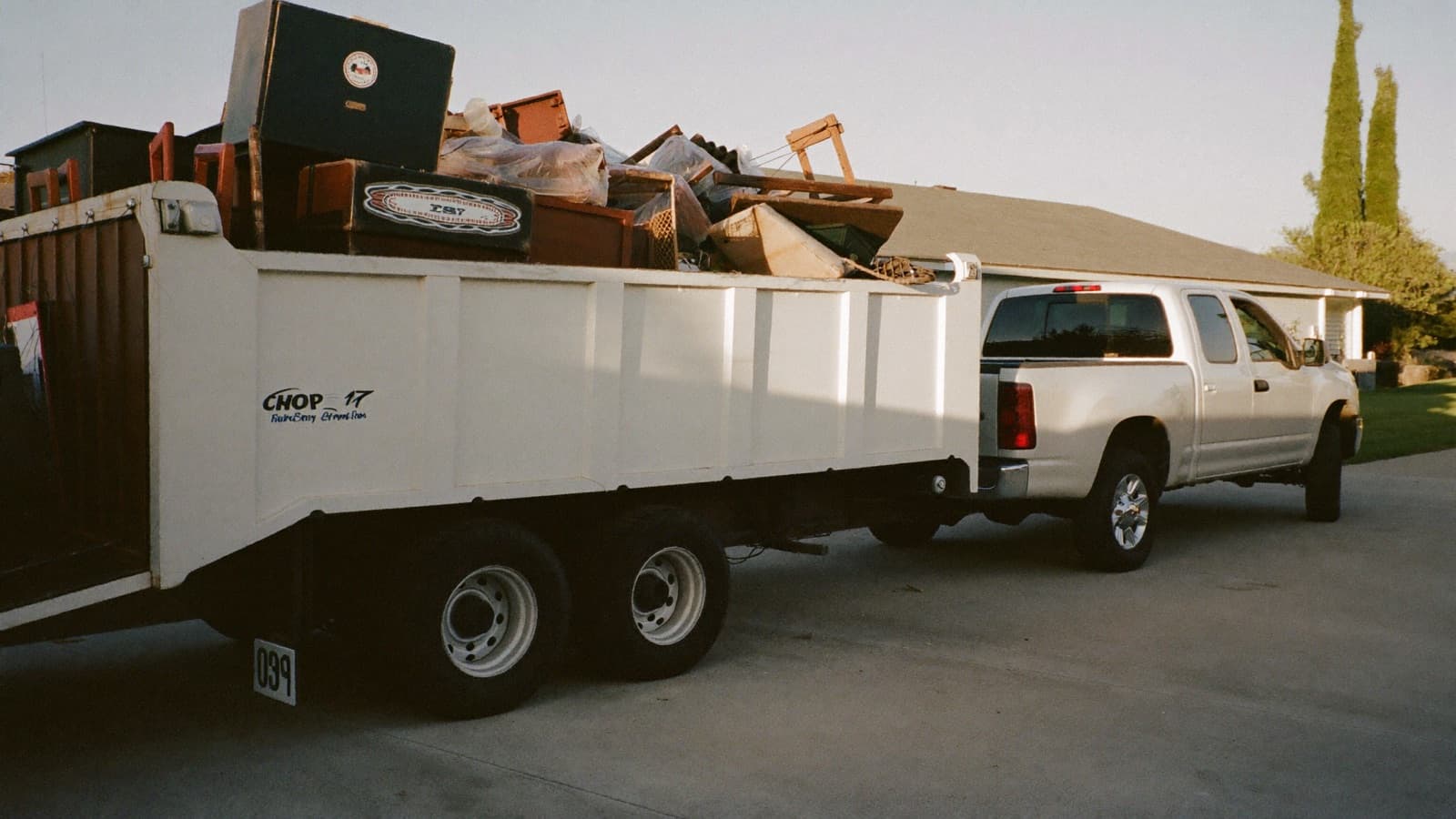
And do not overthink the equipment. Start with the truck you have and rent when a job demands more: Home Depot, U-Haul, Penske. The upgrade ladder is used pickup, then utility trailer, then dump trailer, then a box dump truck. A 6x12x4 dump trailer holds about 10.66 cubic yards and can be financed for around $150 a month. Gear list to start: flat dollies, a hand dolly, gloves, boots, ratchet straps, contractor bags, trash cans, a snow shovel for loose debris, and a sledgehammer. That is it. I compared the trailer and box truck paths in detail in dump trailer vs box truck, and the full startup budget lives in what it really costs to start.
Build the system before the first job
Here is where my start-over plan differs from what most people do. I would not take a single job until the business looks and operates like a real company. Truck-first thinking gets you a hobby. System-first thinking gets you a business.
The prep phase:
- Learn pricing before you quote. Charge by volume (fractions of a truckload), keep dump fees below what a full load pays you, and refuse concrete, dirt, and tile early; heavy debris eats beginners.
- Website with real SEO intent. Not a one-page card. City pages, service pages, submitted to Google Search Console from day one, so the free-lead engine is aging while you hustle.
- Google Business Profile immediately. Get it approved early, load it with legitimate starter reviews from people who know you, add geo-tagged job photos as soon as you have jobs, and reply to every review.
- Look like a company. Branded shirts, a pricing sheet, an A-frame sign, and real decals or lettering on the truck or trailer instead of little magnets.
- Basic operating stack. A CRM for estimates, invoices, and follow-ups, plus missed-call text-back so the phone never leaks. This is exactly the junk removal setup Autopilot was built around, and it is the difference between looking like a guy with a truck and a company that happens to be one guy.
The first $10,000: pure hustle
With the system built, sprint to the first $10K using channels that cost effort instead of money.
- Send a video to everyone you know. A personal video message to your phone contacts announcing the business. Cringe for a day, booked for a week.
- Yard signs, in volume. Put out 100 to 300. This is my highest-ROI channel ever: one batch of 100 signs brought me about $8,000, another batch about $3,500.
- Post like it is a job. Facebook groups, Marketplace, Nextdoor, and Craigslist once or twice a day. Post as a real person, not a logo.
- Walk-ins, daily. Hit 10 to 20 apartment complexes, real estate offices, storage facilities, and nursing homes a day, looking professional, ideally with a gift basket. Property managers hand out repeat work for years.
- Work the job you are on. A-frame sign next to the truck while you load. Offer the customer a small discount to leave a branded sign in their yard.
None of this is clever. All of it works, because almost nobody actually does it at volume.
The 90-day ramp to $1,000 days
Structure the first three months like this:
| Month | Focus | Goal |
|---|---|---|
| 1 | Register the business, EIN, bank account, card reader, website, business number, Google Maps and Yelp profiles | Setup complete before the field |
| 2 | Craigslist twice a day, Thumbtack, guerilla marketing, walk-ins | Reps, reviews, response-time history |
| 3 | Dedicated landing pages plus Google Ads | Paid leads on top of a working machine |
That is the exact sequence I used, and it got me to roughly $1,000 a day in about three months, netting around $500 a day as a one-man operation with my girlfriend helping. Two details that mattered more than they look: a real card terminal with a printed receipt (customers relax when payment feels professional, and the tip prompt pays for the machine), and a binder with a pricing sheet and insurance docs so prices never feel random. I even recorded competitor calls to learn how they quoted and pitched.
Month three is when ads enter, not day one. Google Ads punishes beginners with no landing page, no call handling, and no pricing confidence. Send clicks to a simple dedicated landing page, give campaigns time to learn, and judge them with tracking, not vibes.
Fair warning from the guy who lived it: I was working six and seven days a week and burned out doing it. Build a rest day into the plan. The math above works on six days.
What breaks at $20K a month
Around $20K a month, the thing that made you successful (doing everything yourself) becomes the ceiling. My trucks eventually averaged $2,000 to $3,000 a day each, and at that volume I was fielding 30 to 80 calls a day. You physically cannot load a hot tub and close a phone lead at the same time, and every missed call is a booked job for a competitor.
So the first hires are not muscle, they are systems: scheduling that keeps the route tight instead of criss-crossing town, missed-call text-back so leads get an instant reply while your hands are full, and review and estimate follow-ups that go out without you remembering. Then a helper on the truck, then the phones. That is the bridge from a $100K owner-operator year to whatever you want next, and what owners actually take home at each stage is broken down in how much junk removal owners really make.
I made a full video on the whole start-over plan at https://www.youtube.com/watch?v=rkDyZp2qAbg if you want it in one sitting.
FAQ: making money with a pickup truck
Can you really make $100K a year with a pickup truck?
Yes, and junk removal is the most direct route. At a $400 average job, 50 jobs a month is $20K gross, and an owner-operator keeps around half. The constraint is rarely the truck; it is lead flow and how many jobs a week you can consistently book.
What is the best business to start with a pickup truck?
Junk removal beats the alternatives on ticket size and barrier to entry. It needs no license in most areas, no specialized skills on day one, and customers pay $300 to $600 for a few hours of work. Hauling, moving help, and deliveries pay less per hour for similar effort.
Do I need a trailer to start junk removal?
No. Start with the bed you have and rent for big jobs. A utility trailer is the first upgrade, and a 6x12 dump trailer (about 10.66 cubic yards, financeable around $150 a month) is the sweet spot: more volume per trip means fewer dump runs and better margins. Size loads with a cubic yard calculator until eyeballing is second nature.
How long does it take to make $1,000 a day?
I hit roughly $1,000-a-day revenue in about three months following the sequence in this post: setup in month one, free channels and reps in month two, landing pages and Google Ads in month three. Netting about $500 of each $1,000 as a solo operator.
Put the boring parts on Autopilot
The plan above dies in the details: missed calls, forgotten follow-ups, a schedule scribbled on a dashboard. Autopilot handles the phone, the texts, the booking, and the reviews for one price a one-truck business can afford. Start a free trial or check pricing, and spend your energy on the 50 jobs, not the paperwork.
Find more Autopilot guides on Google
Add Autopilot as a preferred source to see more of our latest advice in Google Search and AI results.