Table of contents
- How a $115,000 job actually comes in
- Bidding a job 100x your average ticket
- What it took to actually do the job
- The numbers: what $115,000 actually nets
- The mistakes that cost me
- The $30,000 job that came before it
- Why big jobs come from boring channels
- FAQ: landing the biggest junk removal jobs
- Be ready when the whale calls
The biggest junk removal job my company ever completed was $115,000. One customer, one warehouse, one Fortune 500 company. It took 45 to 60 days, 30 to 50 truckloads, forklifts, semi flatbeds, and machinery that weighed up to 10,000 pounds. And the lead did not come from networking, a vendor list, or a commercial sales team. It came from a Google ad.
Most operators never bid a job over $5,000, so when something 100 times their average ticket shows up, they either run from it or fumble it. I did a bit of both, and the mistakes I made on this job cost me real money.
Here is the whole story: how the biggest junk removal job of my career came in, how I bid it, what it actually netted, and the contract lessons I will never skip again.
How a $115,000 job actually comes in
I had been running Google Ads consistently for about a year and a half to two years when the email arrived. A Fortune 500 company needed a warehouse cleared. That timing is not a coincidence, and it is the single most important lesson in this post: whales come from boring, consistent exposure.
The customer first sent a PowerPoint with small photos and asked for a price. I refused to bid from it. There was no way to see the density of the material, the size of the machinery, or the access from a slide deck. I drove out and walked the site instead.
If you take one operational habit from me, take that one. Photos are for screening. Feet on concrete are for pricing.
Bidding a job 100x your average ticket
At the walkthrough I found a warehouse full of trash, boxes, paper, and debris, plus rows of industrial machinery that were completely outside my normal scope. I almost walked away. Then I decided I would rather lead the project and subcontract the part I could not do than hand a six-figure job to someone else.
Here is how the numbers moved:
- I anchored verbally at the walkthrough: this is a $100,000 to $200,000 project.
- I sent a formal estimate at $150,000.
- The customer countered around $125,000.
- We closed at $115,000, after the machinery subcontractor I brought in first quoted me $50,000 and then reduced their price.
The anchor did the heavy lifting. Because I set the range in person, $115,000 felt like a deal to the customer instead of a shock. A clean, professional estimate with real scope language matters at this size; nobody wires six figures against a text message.
The subcontracting move is the part most operators miss. You do not need to know how to rig a 10,000-pound machine. You need to know who does, and you need the customer trusting you as the lead contractor who makes the whole problem disappear.
What it took to actually do the job
The scope was a monster. Thirty to fifty loads of trash and debris. Machinery from 2,000 to 10,000 pounds. Furnaces that had to be broken open so the concrete and insulation inside could be removed before the shells went to scrap. A giant water cooler attached to the building. Heavy metal shelving, upstairs debris, outdoor containers, and specific machines the client wanted kept, sitting right next to ones that had to go.
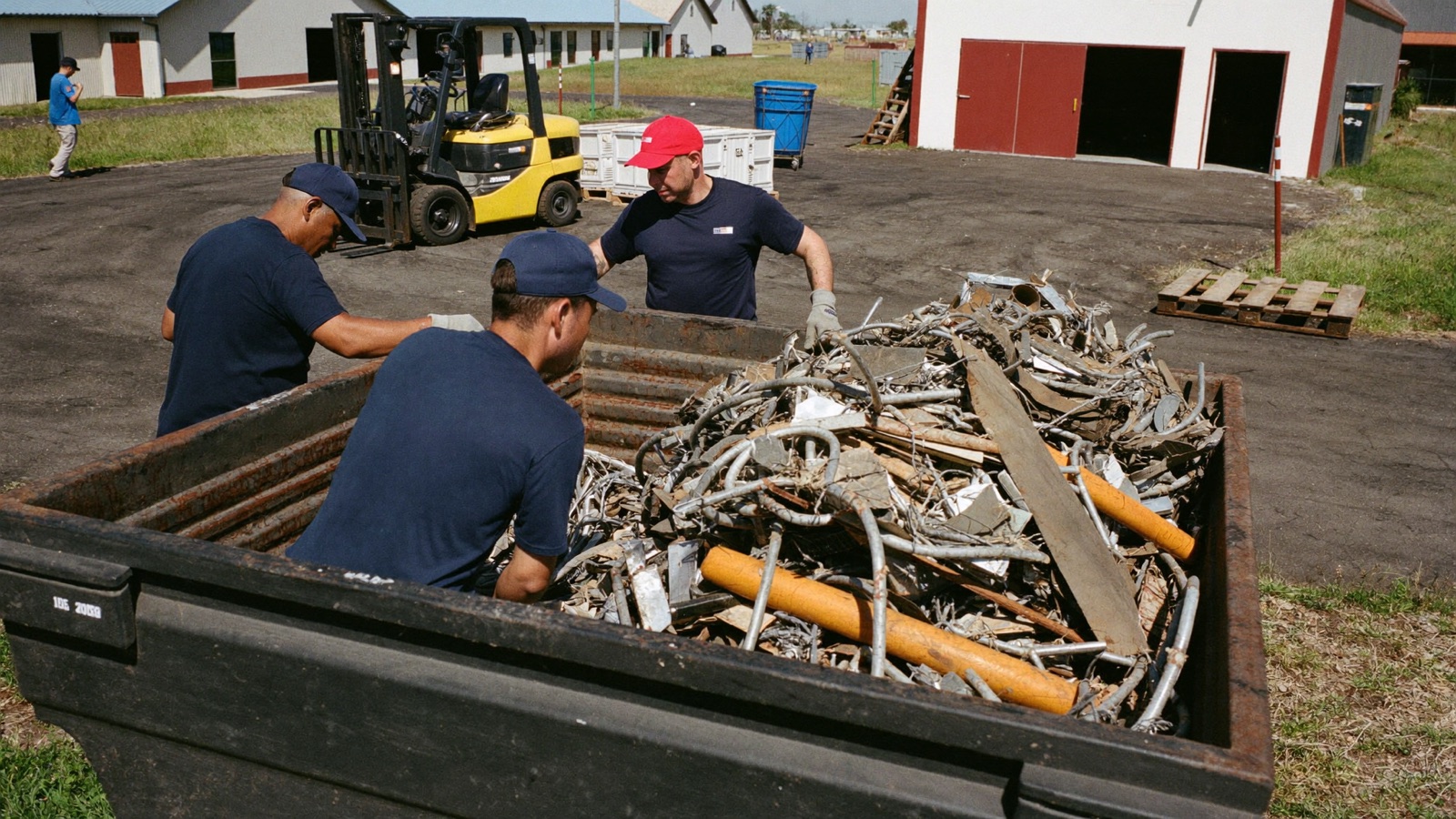
Execution was improvisation for two straight months. We rented equipment mid-job, bought demo hammers and a used generator, coordinated forklifts and semi flatbeds, ran load after load to the scrap yard, and still had to extend the deadline. I was driving an hour each way while my residential crews kept the normal schedule alive.
I made a full video walking through the job while it was happening. Watch it here if you want to see the warehouse with your own eyes.
The numbers: what $115,000 actually nets
Time for the part gurus skip. Revenue was $115,000. My expenses ran roughly $51,000 before labor: the machinery subcontractor, dump fees, fuel, equipment rentals and purchases, commissions, supplies, and a scrap metal rebate that went sideways (more on that in a second). Labor added about another $20,000.
Best estimate: somewhere between $35,000 and $55,000 in profit for roughly two months of chaos layered on top of my normal operation. Real money, absolutely worth it. Also nowhere near the number people imagine when they hear $115,000. I broke down the full lessons in this video.
The mistakes that cost me
The scrap deal was never written down. The customer expected the scrap metal proceeds back. My subcontractor believed the scrap was theirs, baked into their reduced price. Both sides were sure, because I let a five-figure detail live in verbal conversations. On a job this size, every dollar flow goes in the contract. Every one.
The payment terms were weak. I accepted about 20 percent down, another payment at completion, and the rest net 45. That means I financed a Fortune 500 company's cleanup with my small business's cash flow while payroll, fuel, and rentals went out the door weekly. Big companies will happily agree to slow terms if you sign them. Ask for bigger deposits and progress payments tied to milestones, and make your invoicing send the moment each milestone lands. If commercial work is your target, my post on getting commercial junk removal contracts covers vendor setup and net-30 reality.
I underestimated the duration and the demo. Breaking open furnaces to strip concrete and insulation was basically light demolition that I priced as hauling. The deadline slipped and the equipment bills grew.
None of these killed the job. All of them shrank the margin. Six-figure projects punish vagueness with a precision that $300 couch pickups never will.
The $30,000 job that came before it
The $115,000 warehouse was not my first rodeo with scope creep. My previous biggest junk removal job was a $30,000 burned-machinery and demolition project, also from Google Ads.
It started as roughly a $16,000 scope. Then the concrete walls and rebar pushed it to $25,000 to $26,000, and I aimed to collect $30,000 by the end. The site had about a dozen burned heavy machines and roughly 12,000 pounds of scrap metal that we hauled in four loads. I rented a Kubota excavator, ran a skid steer at about $230 a day, and hired four gig workers from Craigslist at $20 an hour when my regular crew was off.
The lesson that saved me: I overbid, and I rebid when the scope changed. The job ran harder and longer than planned, with a full day of cutting rebar I never saw coming. If I had priced it tight and treated the scope as fixed, I would have worked a month for free. Big demo jobs need margin for equipment damage, safety, and time overruns, because you will use all three.
Why big jobs come from boring channels
Both of my biggest jobs, the $30,000 and the $115,000, came from long-running Google Ads. Not from cold outreach to real estate companies. Not from vendor lists. Not from a commercial sales rep. The unglamorous machine I fed every single month for years is what delivered the whales, which is exactly why I tell everyone to master junk removal Google Ads before chasing exotic channels.
There is a quieter lesson under that one. The monster jobs sit on top of a foundation of ordinary days. The same operation that landed the warehouse was also grinding out $10,545 across eight regular jobs in two days that same era, protecting 50 to 60 percent margins by picking the right dumps and routing tight. Whales are a bonus on top of a healthy business, not a substitute for one. And when a hoarder house or estate cleanout is the biggest thing on your board, the same walkthrough-and-anchor playbook applies; I wrote up how I price hoarder house cleanouts separately.
Keep the ads running. Answer every call. The big one shows up on a random Tuesday.
FAQ: landing the biggest junk removal jobs
How do junk removal companies get huge commercial jobs?
In my experience, from consistent visibility rather than outbound sales. Both of my biggest jobs, $30,000 and $115,000, came through Google Ads I had been running for one to two years. Commercial facilities managers search like everyone else, and the company that shows up and answers gets the walkthrough.
How do you bid a job way bigger than your normal work?
Walk the site, never bid from photos, and anchor a wide range in person before sending a formal estimate. Price for scope creep, subcontract what you cannot do yourself, and stay positioned as the lead contractor. Overbidding slightly saved me on both of my biggest projects.
What deposit should you take on a big cleanout?
More than I did. My 20 percent down with the balance dragging to net 45 forced me to float two months of labor, rentals, and dump fees. Push for a bigger deposit and progress payments at defined milestones, in writing, before the first truck rolls.
How much profit is in a $115,000 junk removal job?
Mine netted an estimated $35,000 to $55,000 after roughly $51,000 in non-labor expenses and about $20,000 in labor. Strong money, but the margin only survived because the job was anchored high and rebid honestly. Priced casually, a job like this can lose money.
Be ready when the whale calls
The $115,000 email looked like every other lead when it arrived. The difference was an operation that answered fast, estimated professionally, and invoiced like a real company. Autopilot gives you the estimates, invoicing, and follow-up to handle the biggest junk removal job of your life and the six normal ones behind it. Start a free trial or look at pricing before your random Tuesday shows up.
Find more Autopilot guides on Google
Add Autopilot as a preferred source to see more of our latest advice in Google Search and AI results.